
The Manual do Usuário app
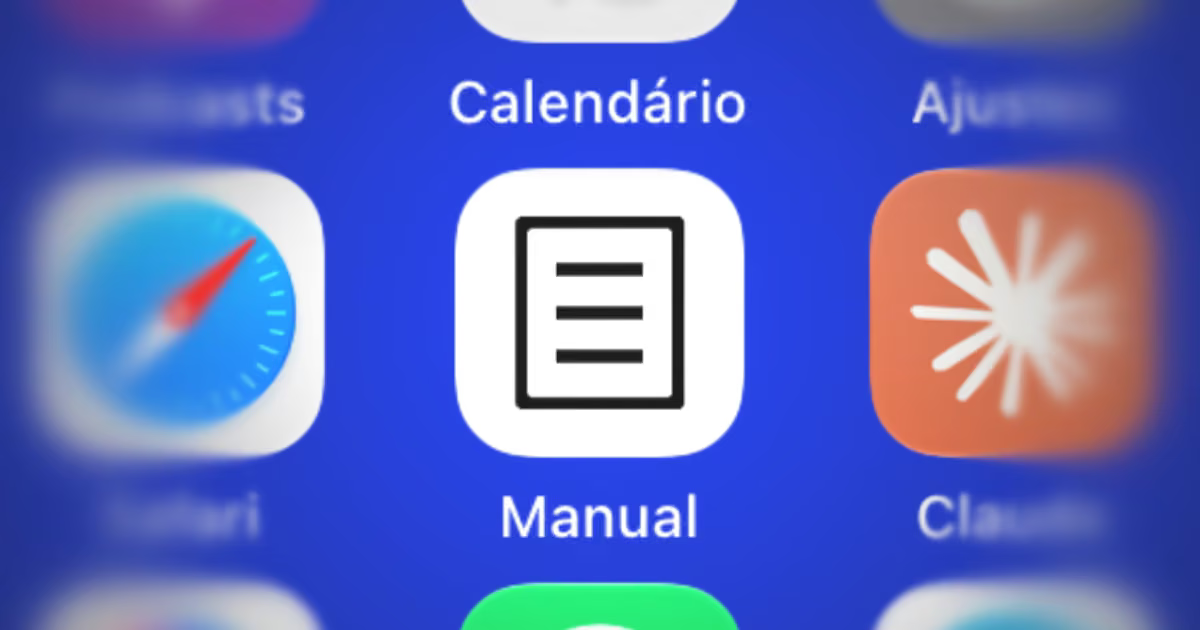
You may not know this, but Manual do Usuário is both a website and an app. It isn’t obvious, because the app isn’t available on Apple’s or Google’s app stores. You install it straight from your web browser.
In Safari on the iPhone, open the blog’s homepage, tap the browser’s share icon (the little arrow poking out of a square) and look for “Add to Home Screen.” In the sheet that slides up, leave “Open as Web App” checked and tap “Add.”
In Firefox on Android, open the blog’s homepage, open the browser menu (the three stacked dots), tap “More” and then “Add app to Home screen.”
In Safari on macOS, open the blog’s homepage and go to File, then “Add to Dock.” In the window that pops up, click “Add.”
Using Chrome or another Chromium-based browser? Google’s help page walks you through it.
In every case, a new icon, just like any other app’s, will show up on your phone’s home screen or somewhere on your computer.
***
This kind of app is called a “Progressive Web App” (PWA). In practice, it’s just a little extra seasoning a developer adds to a website so it behaves more like a native app, with features like working offline, push notifications and access to the device’s file system.
PWAs are the evolution of the mid-2000s idea of the web as a platform (“Web 2.0”) and, at the same time, a leftover from a future that never came to be.
Back in 2007, before they even had that name, PWAs were Steve Jobs’ and Apple’s bet for filling the brand-new iPhone with third-party apps. The App Store and native apps would only arrive a year later. Someone at Apple must have noticed the cool stuff the iPhone jailbreaking crowd was doing, and from there to spotting the pot of gold at the end of the rainbow was a short leap. By pot of gold, I mean a 30% cut of digital transactions in a centralized store. Hard to resist. The rest is history.
Funnily enough, in the nearly two decades since Apple’s brief, failed foray into PWAs, it was Google that “adopted” the strategy and pushed it forward, partly because of ChromeOS and its attempt to turn Chrome into a parasite that burrows into other operating systems and slowly takes over its host.
To this day, Chromium (Chrome’s open source foundation) has exclusive technologies along these lines, like the WebUSB specification, which lets the browser see devices plugged into the computer’s USB ports.
The other two major browsers, Firefox and Safari, offer basic support, including push notifications.
Chromium-based browsers have another quirk: in them, a website can display an install button. The Manual now has one, up in the header. Once you install the app, the button disappears when the Manual is opened through the PWA.
***
Nobody can stand notifications anymore, I know, but I offer them here at the Manual. (Wait a few seconds for the browser’s native pop-up or click the corresponding button in the blog’s main menu.)
It’s a pretty straightforward feature: sign up and you’ll get a notification for every post published here. These days there aren’t that many: one a day on average, three at most.
I suspect a lot of people turn on notifications without knowing what they’re doing. It’s a common problem, from what I hear talking to other site owners.
Around here, the click-through rate (CTR, in ad-speak) is 0.6%. I hope those clicks are intentional.
***
“Google Zero,” the tipping point when Google stops sending readers to a website, is coming for the Manual.
The short window of traffic stats I have shows a brutal drop in visits coming from Google Search, from 22,664 in July to 4,652 in October, a 79.5% plunge. I imagine that number was much higher a year ago, and higher still before Google’s AI Overviews and AI Mode.
(I know a lot of readers use ad blockers, which keep visits from being counted, but I suspect that’s not the case for most people who land here from Google… right?)
Content sites have been turning to other ways of staying in touch with their readers. Our friends at Núcleo, a Brazilian tech news outlet, for example, built native apps for Android and iOS. I don’t have the hands, and my Claude doesn’t have the tokens, to go down that road. For now, the PWA is what we’ve got, and I hope this heads-up gets more people to use it.
Website discovery on the web is going through an irreversible upheaval as Google collapses as a source of traffic. Without the firehose of visits from search engines, word of mouth will be king again. And by “word of mouth” on the web, I mean links on other sites, recommendations, and shares in group chats and other closed spaces.
I’m not too torn up about this new reality. A small part of me has always had a soft spot for the idea of a blog as a place to stop by, rather than a pit stop for people browsing the web from search engines. We got hooked on that middleman, to the point of typing “gmail” into Google instead of “gmail.com” into the browser to get to the service.
The Manual, and every site that ignores the desperate race for clicks, is increasingly the “indie web.” There’s something beautiful about that.