Blocking of unverified apps on Android starts in Brazil and other three countries

Google’s new arrangement for installing unverified apps on Android takes effect this Thursday (Oct. 1st) here in Brazil.

Indonesia, Singapore, and Thailand are also among the first countries to be affected.

F-Droid and other free and/or Google-independent initiatives have been raising a ruckus over the changes. They are, indeed, an extra hurdle for apps distributed without Google’s blessing. Verifying an app means identifying yourself to Google, which — understandably — many developers don’t want to do.

Heads-up! In July, Google announced that the first phase, running from now through 2027, will only affect apps distributed through specific stores: its own Play Store, Honor, Oppo, Samsung, Transsion, Vivo/Jovi, and Xiaomi. In other words, F-Droid got a breather until 2027. What a mess!

I covered the story [pt_BR] here at Manual before Google unveiled the so-called “advanced flow” for enabling the phone to install unverified apps. The flow, as per Google, works like this:

  • Enable developer mode in system settings. Activating this is simple. This prevents accidental triggers or “one-tap” bypasses often used in high-pressure scams.
  • Restart your phone and reauthenticate. This cuts off any remote access or active phone calls a scammer might be using to watch what you’re doing.
  • Come back after the protective waiting period and verify. There is a one-time, one-day wait and then you can confirm that this is really you who’s making this change with our biometric authentication (fingerprint or face unlock) or device PIN. Scammers rely on manufactured urgency, so this breaks their spell and gives you time to think.
  • Install apps. Once you confirm you understand the risks, you’re all set to install apps from unverified developers, with the option of enabling for 7 days or indefinitely. For safety, you’ll still see a warning that the app is from an unverified developer, but you can just tap “Install Anyway.”

I’ll play devil’s advocate here and say… this seems like a good measure? I know that in an ideal world (or for those who live and breathe tech) the phone is yours and you do whatever you want with it, but in the real world there are millions of elderly people, people with low literacy, teenagers, and people who simply have better things to do, all left at the mercy of scammers all day, every day.

It’s worth noting that this arrangement only applies to phones running Google-certified Android. On alternative systems without Google’s underpinnings, such as LineageOS (without microG), GrapheneOS, and HarmonyOS (Huawei’s), nothing changes.

For those who know what they’re doing, the “advanced flow” only needs to be done once. Its effects even carry over to new phones.

Coincidentally, the start of Android’s app verification coincides with Brazil’s ban on online gambling, enacted by the Lula administration through a provisional measure (an executive order with the force of law) last Friday (25th). The extra difficulty in installing unverified apps may help defend against illegal betting apps, as long as they aren’t verified with Google — which isn’t the case for operators that were licensed in the country.

Another week on Linux

Sometimes I get bitten by the free software bug. I’ve followed the consumer tech industry for decades, and immersed in that universe, it’s hard not to grow disillusioned with its monopolies, questionable practices, and normalized abuses. Although disdain for big tech is more fashionable these days, we’re far from any universal, practical shift because — let’s face it — that shift comes at a cost. Try convincing someone to swap WhatsApp for Signal, for instance.

In late July, my free software fever reached dangerous temperatures. Once again, I found myself installing a Linux distro with the intent of freeing myself from macOS, the first step out of Apple’s walled garden; I thought I was standing at the door of a digital utopia, something like the modern-day dream of dropping everything to go live off the land.

(more…)

These tacky men with ridiculous glasses want you to wear them too

Meta — the same company that declared in 2021 that by now you’d be living in the “metaverse” — sold a few million camera glasses for pervs and, all of a sudden, the next future envisioned by Mark Zuckerberg’s unhinged mind is one where we all walk around wearing camera glasses powered by “artificial intelligence.”

Yes, Silicon Valley CEOs believe the best way to curb screen addiction at 20 cm from your face is to strap screens 20 mm from your eyes.

(more…)

I almost got hit by a car

In early June, while visiting my parents in a small town in the interior of Brazil, I decided to skip the gym and make a quick run to the pharmacy — the first signs of a migraine had set in, and that’s the best time to take something before it gets worse.

The nearest pharmacy is about 1,5 km (a mile) away. I laced up my running shoes to make it worth the trip: a light walk to pick up the medicine.

On the way back, I decided to change my route and loop through a small square where, when I used to live there, I’d often go for walks.

Almost back at my parents’ house, I crossed a busy avenue without incident. On the other side, I had a momentary lapse and assumed the cross street was one-way. (It actually is — but only on the other side of the avenue.)

I looked one way, saw no cars or motorcycles, and stepped out.

(more…)

How AI chatbots manipulate you and undermine your privacy

At the risk of being among the first victims of artificial intelligence in a potential machine uprising, I keep my interactions with today’s generative AIs (or AI chatbots) strictly transactional.

I open the site, ask or request what I need, get the answer, close the site. No names, no pleases, no thank-yous, no small talk. I avoid anthropomorphizing them as much as possible. I treat them for what they are: statistical machines churning out words that make sense, not a new form of sentient life — at least, not yet.

Keeping a transactional relationship with AI chatbots is, for me, a way of keeping the line between us clearly drawn, to ward off an unlikely — but not impossible — “AI psychosis,” the kind of spiral where someone genuinely believes the AI is alive.

A newly published report by the Center for Democracy and Technology (CDT), authored by researchers Ruchika Joshi, Adinawa Adjagbodjou and Michal Luria, gave me further reasons to stand by that approach.

(more…)

Brazilian Internet Forum (FIB16) in Belém, Pará: A visual tour

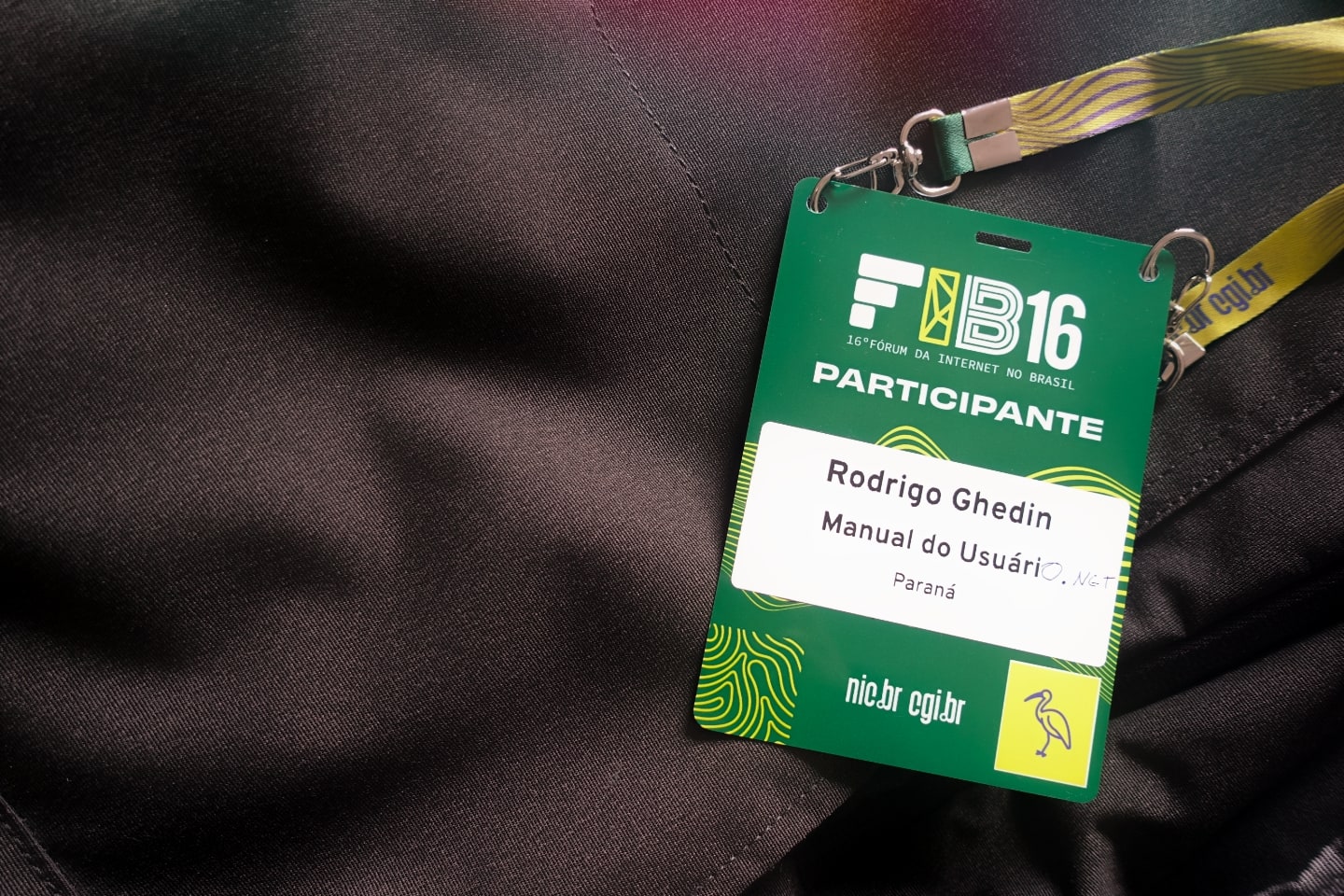
Crachá do FIB16 de Rodrigo Ghedin, do Manual do Usuário, Paraná, sobre uma bolsa preta.

I had the opportunity to participate in yet another edition of the Internet Forum in Brazil (FIB16), this time in the Amazon forest region, in Belém, Pará. The event, organized by NIC.br, brings together people from different sectors to debate hot and/or important topics related to the internet in the country.

My FIB16, however, was a bit different. Like the previous edition in Salvador, Bahia, I came here hired by NIC.br to host the interview podcast Nós da Internet. I opted to stay for fewer days this time, which packed my interview schedule and kept me from attending the panel discussions. (A tip that’s useful for me: all of them were streamed and are available on YouTube.)

To not miss out on covering the event for this Manual, I thought I’d document the venues and moments of FIB16 and the behind-the-scenes of Nós da Internet in photos. Also, a few more pictures of Belém and its touristic spots.

It had been a long time (really long) since I’d photographed anything other than family events. Ignore the weird angles, blown-out lights, and strange colors. I noticed I’d forgotten everything I ever knew about photography — which, to be honest, was never much to begin with.

(more…)