
RCS, SMS via the internet, is good, but that doesn’t matter
In 2024, Apple made a gesture of goodwill to European regulators and opened iOS 18 to RCS, the evolution of the old SMS. Great, but too late.
RCS, which stands for Rich Communication Services, is SMS via the internet with all the benefits that come with this improvement, such as support for high-quality images, read receipts, typing indicators, and audio messages.
In other words, it is the “WhatsApp version” of SMS.
Brazilians with iPhones had to wait another year. Support depends on carriers and (I think?) negotiations with Apple. Brazilian carriers seemed in no hurry to offer RCS to these customers.
Vivo carrier users got RCS on iOS 26. TIM customers were graced with it on iOS 26.2. Claro users will receive it on iOS 26.3, which is expected to be released in early 2026. These are the three major carriers here.
On Android, RCS has been a first-class passenger for many years. This is no coincidence, since Google is the main force behind RCS and sees it as the best chance to compete with iMessage in the United States. That blue bubble and green bubble annoyance that only exists there.
In the rest of the world (except China), WhatsApp reigns supreme, and where there is WhatsApp, no one cares about RCS, SMS, or any other messaging app.
***
Excited about the arrival of RCS in Brazil, I decided to do some testing. Not only because I dislike depending on a Meta app, but because WhatsApp is very, very bad. Heavy, invasive, full of extras that don't interest me (Status, channels etc.), as well as being a source of user data used by Meta for who knows what. The desktop app is unbelievably bad; how can a messaging app need 1.5 GB of memory to run?
Messages, Apple's default app for SMS, RCS, and iMessage, isn't the best thing in the world, but it's light years ahead of WhatsApp. It's lightweight and straightforward. Still. With every major iOS/macOS update, Apple adds more bells and whistles to Messages, a remarkable effort to try to make worse something that was fine the way it was ten years ago. (On Android, access to RCS via computers is through a website.)
The tests began with the Manual‘s paying subscriber chat group (in pt_BR), which operates on — you guessed it — WhatsApp. One fine day, it occurred to me that it would be cool to migrate the group to RCS. And… why not? After all, I didn't have to get rid of the WhatsApp group to have the RCS group; the two could coexist for some time.
The first test soon proved to be the most challenging. RCS was not designed for large groups with strangers or semi-strangers. It lacks moderation tools, anyone can change everything in the group, and there are several annoying details that, when added up, become a major nuisance.
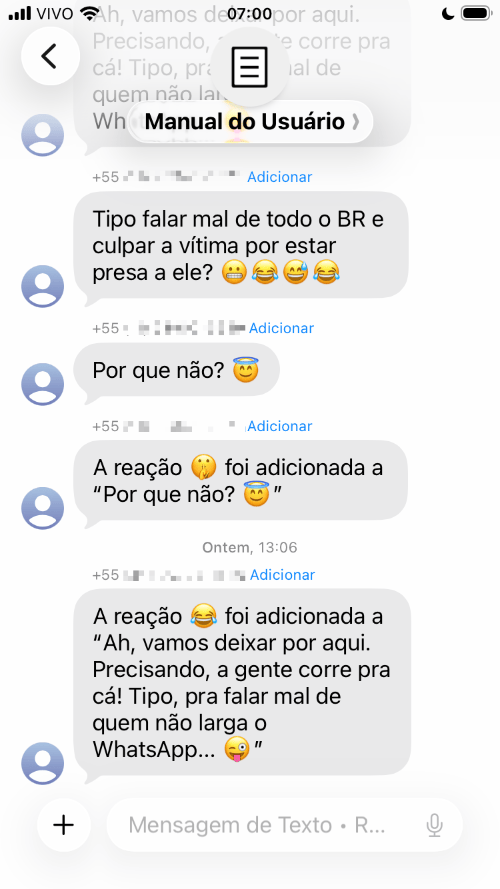
Imagine this in a large group with dozens of people. It doesn't take long for the environment descend to chaos.
Another regression is the lack of direct replies to messages. In iMessage, the system is one of the most elegant. In RCS, it doesn't even exist.
Identification also didn't work, even though both apps (Android and iOS Messages) support name and user picture. It worked for a few people. Most appeared with a default avatar and their phone number as their only identifier. I joked that we would start calling each other by the last four digits of our numbers.
***
It's hard not to imagine that these lapses are intentional, like the nonsense of green/blue message bubbles.
It sounds petty, but it's not surprising. In 2022, at a press conference, one of them asked Apple CEO Tim Cook about RCS support, which was then non-existent on iOS, arguing that his mother couldn't see the videos she sent. He replied that the person should buy an iPhone for his mother. Classy!
The worst problem, however, took a few weeks to manifest itself. When the group was already deserted, I sent a message asking if anyone was still there.
The message broke up the group.
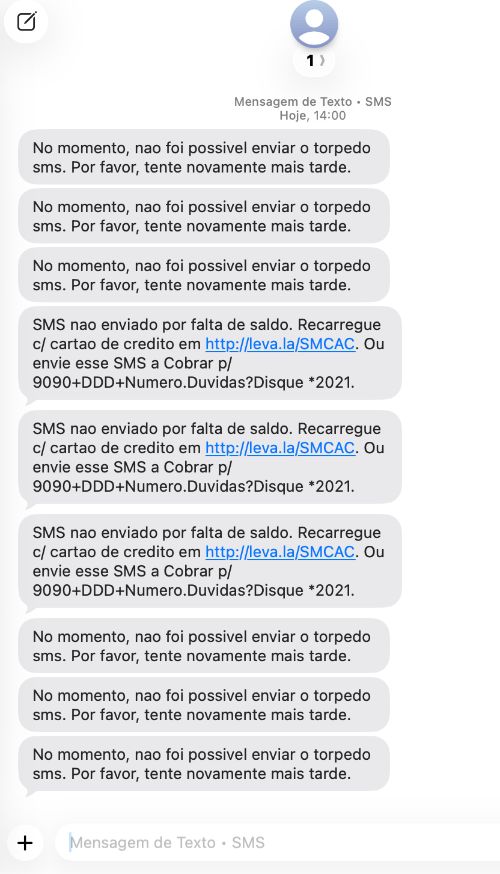
The story gets even stranger because the group only had people with iPhones or Android devices that support RCS. It was done this way because the system levels down: if a person without access to RCS joins, the group becomes an SMS group, i.e., full of limitations.
Did someone change carriers? Did a phone “forgot” about RCS? Or did some carrier error cause a temporary outage that destroyed the group?
The same problem occurred in another smaller group I created with my family (one iPhone on Vivo, two iPhones on TIM, and one Android on TIM). With fewer people, it was possible to verify that the phone that caused the breakdown was one of the iPhones on TIM.
For private conversations between two people, RCS works well. My partner at Célere agreed to migrate from WhatsApp to RCS, moved by the struggle my laptop, with its meager 8 GB of RAM, had to run WhatsApp Web in parallel with other applications.
Yes, the minor inconveniences already mentioned (strange reactions, lack of direct responses) persist. Otherwise, everything works as expected, which means it works well, even with the green bubbles.
(The discomfort with the colors, incidentally, is not unfounded. The contrast ratio of the white letters on the shade of green adopted by Apple, #35C95B, has a very low contrast, which makes reading difficult. The blue bubbles, #1493FE, are not much better, just a little less worse, which already makes a big difference.)
I was also able to talk to people who are not connected to technology. They were surprised by the existence of RCS, an acronym they were unfamiliar with. We had no problems exchanging messages.
***
Without context, RCS works well. I could use it instead of WhatsApp without any loss and with fewer features that I consider unnecessary, such as stickers. (I know I'm the annoying minority here.)
The experience is only broken when you demand a little more, such as using it for large groups. Even with exciting new features on the horizon — the upcoming end-to-end encryption between iPhone and Android that should appear in iOS 26.3 —, it's difficult for an open standard to keep up with closed ones. Consensus is difficult, after all.
Even if RCS managed, by some miracle or regulatory imposition, to keep up with third-party apps, the sad truth is that it doesn't matter. WhatsApp's gravitational pull in places like Brazil is so overwhelming that it has managed to override a standard app that comes pre-installed on every phone. That's no small feat.
Carriers seem comfortable with WhatsApp's dominance, or uninterested in competing with Meta. The slow pace of RCS's release for iOS in Brazil is a strong indication. Another long-standing problem is the abuse of SMS/RCS, which have become synonymous with scam attempts, spam, and two-factor authentication (2FA) codes. The industry boasts of turning the app into a digital dumping ground.
A friend with whom I tried to chat via messages (iMessage, in this case) hadn't even noticed that I had sent her a message. She only saw it hours later, when I mentioned it in person. Another had already disabled notifications from the messaging app, and I was lucky that she opened it to get a 2FA code a few minutes after I sent one.
I still think it would be possible to turn the tide: with a comprehensive media campaign, better conditions across all plans (i.e., free SMS and RCS), an end to zero-rating for WhatsApp, and other incentives. If that happens, it will be great. Someone let me know on WhatsApp, please.