
People using a Logitech mouse on macOS spent a few hours with limited functionality. An expired certificate for the Logitech Options+ and G HUB apps caused the confusion. The ridiculous issue at least served to help people discover better alternative utilities for this purpose. (The best software, however, is no software; a good mouse works fine without these things, hehehe!)
English
Doppi, the nicest player for your music files

In my first adventure returning to music files (*.mp3, *.flac) in 2023, I mentioned an iOS app called Doppi as a great discovery. It was the app I chose to accompany me on my second attempt, which was successful this time.
That’s why I thought it was worth highlighting the app (“the nicest player for your music files”). Not only is it great, but it has also gotten some amazing new features:
Tech CEOs: Workers MUST be present in the office. The job simply cannot be done remotely.
Also tech CEOs: Most workers can be replaced by AI. Hosted remotely.
 SaraMG
@saramg@fosstodon.org
Dell and Microsoft, marketing geniuses
Remember when Warner Bros. changed the name of its streaming service from HBO Max to Max, and then less than a year later back to HBO Max? Or when the richest person in the world proved that money has no relation to intelligence and threw the “Twitter” brand in the trash? Marketing geniuses!
Maybe it's late capitalism, maybe it's a side effect of new drugs circulating among the bigwigs of the world's most powerful companies. Or maybe it's just plain stupidity. The fact is that the practice is spreading, and fast.
In early 2025, Dell revamped its line of notebooks and retired traditional names, including XPS, perhaps the most recognizable after Apple's MacBook. The goal was to simplify. No one understood anything.
Cut to 2026, and Dell announced at CES, to no one's surprise, that it will return to using the XPS brand. They look nice.
Running behind is Microsoft. When accessing the office.com website, we come across this gem (my highlight):
Welcome to the Microsoft 365 Copilot app
The Microsoft 365 Copilot app (formerly Office) lets you create, share, and collaborate all in one place with your favorite apps now including Copilot.*
Just imagine, replacing the brand that has been synonymous with productivity apps for three decades with… Copilot, a slop generator that people generally dislike and only use because their employer requires them to.
Good for us. The less we associate critical software with big tech brands, the better. Long live Microsoft 365 Copilot — or whatever other weird name Word, Excel, and company end up with in the future.
Office files in BentoPDF; customizable YouTube subscriptions in Miniflux
Two services from PC do Manual, our FOSS apps server, have gotten some cool new features in recent weeks. These versions are already active on our server.
BentoPDF, a Swiss Army knife for file actions *.pdf, has received its "biggest update" yet.
The flagship feature of version 1.15.1 is support for Office files. And not just Microsoft 365; it also converts to *.pdf files in OpenDocument Format (LibreOffice), *.pages (Apple Pages), *.pub, *.vsd, *.psd (Photoshop), *.rtf and csv. Phew!
In the opposite direction (*.pdf to Office), for now there is only support for Word and Excel files.
Other file formats have been added, notably e-books and images.
BentoPDF processes files locally, on the device of the person accessing it. This ensures the privacy of the files processed by the tool.
***
Another piece of good news comes from Miniflux, an RSS feed aggregator exclusively for paying subscribers.
Version 2.2.15 has improved support for YouTube subscriptions. Now, when registering a channel feed there, Miniflux offers four options:
- Channel: All videos.
- Videos: Only long videos, no Shorts or live videos.
- Short videos: Only short videos/Shorts.
- Live streams: Only live videos.
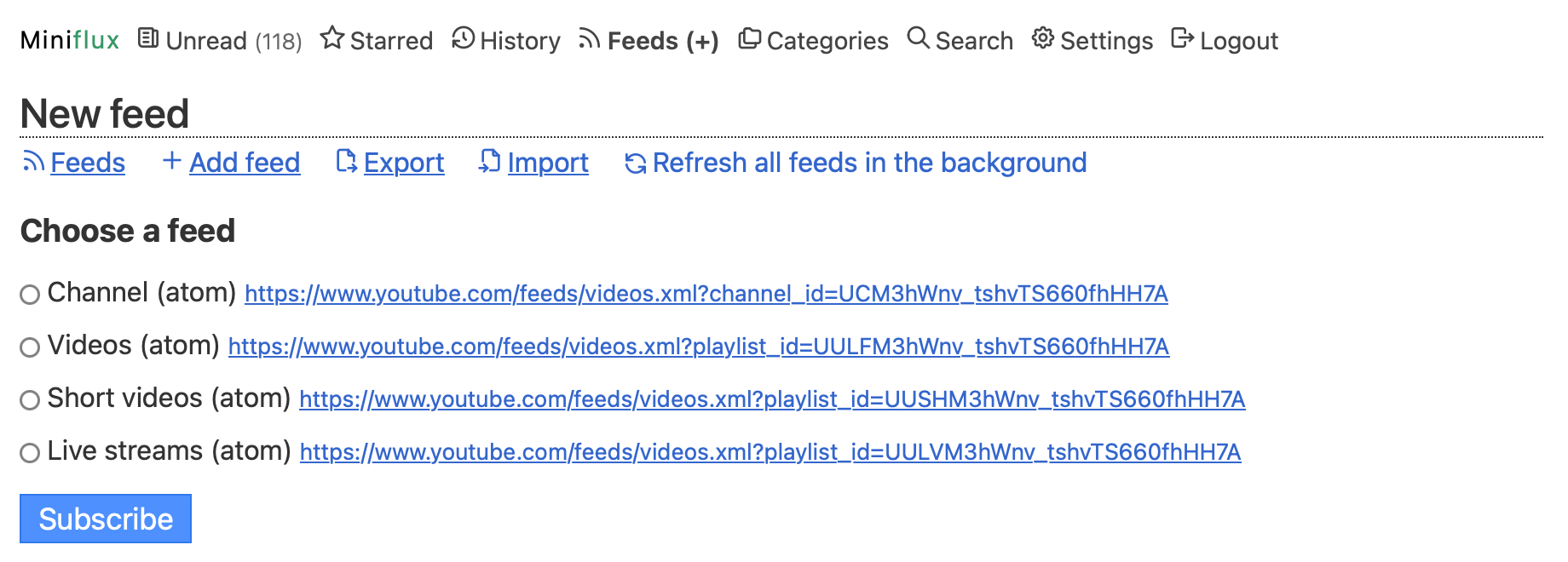
It is possible to do this in other ways, by directly editing the feed URL. Thiago showed how to do this on Órbita last year (pt_BR). However, Miniflux's one-click option is much more intuitive and expands the option to get rid of Shorts to a larger/less technical audience.
2025 has been a disaster for Windows 11  windowscentral.com
Zac Bowden wrote a long article stating that Windows fans (the author's definition) have been sold a “disastrous 2025 for Windows 11.” I haven't used Windows in many years and have barely touched version 11, so I read it with extra attention.
Anyway, I'm sure you can guess the most obvious problem with Windows 11 in 2025:
New year, new theme
I was working on a revision of the Manual WordPress theme to coincide with our upcoming migration from WordPress to ClassicPress. I couldn't resist and implemented it here on the blog while still on WordPress. (ClassicPress is scheduled to come into play in March.)
One of the new features is this behind-the-scenes "mini-blog" separate from the main blog's front page. For those who follow via RSS feed, nothing changes. The distinction is purely structural and only valid for the pt_BR version — in English, all posts appear on blog’s homepage.
The new version of the dez theme, 4.0, brings other cool new features that I intend to explore thoroughly. (I follow the "pride versioning" approach, which calls for major releases when the person is proud of what they've done.)
Of what is noticeable to readers in dez 4.0, I highlight three things:
- A new post format, link, which I will use to comment on texts by other authors. The inspiration for this is Jim Nielsen's blog notes. I will suspend the holiday break on next Monday (5th) and publish the first of this kind.
- Now, all of the cool links posts appear on the home page. Until yesterday, only the last one published was displayed, and to see the others, you had to access the archive.
- Several minor adjustments to the layout in order to simplify it. For example, the main menu has been vanished in the English version. The margins and spacing between elements are now more consistent, and I have made greater use of dashed borders to separate them visually.
In addition to more granular behind-the-scenes information about the site, which was previously restricted to the newsletter log, I will also replicate the news from the PC Manual here, our public FOSS apps server.
The first of the year, in fact, is the Readeck test, a free and modern FOSS alternative to the late Pocket, Instapaper, ReadWise Reader, and the like — a “read it later” type app. If you are a paying subscriber, send an email requesting your access credentials.
The drawing for Brazil’s largest lottery prize ever — BRL 1 billion (USD 180 million) — was postponed due to the volume of bets, which reached 125,000 per second, 120,000 of them via digital channels. The draw, originally scheduled for 10 PM on Wednesday (31st), was moved to this morning. I hope they actually make it this time.
Via O Globo (pt_BR).
Mozilla said Firefox will have a “kill switch” that disables all AI features in the browser. Someone witty quipped it will be the “Uninstall” button.
The iPhone 16e is good, actually
MKBHD gave the “Burst of the Year” award to the iPhone 16e, Apple’s entry-level phone released in the first half of 2025 to replace the tired (but beloved) iPhone SE. The Basic Apple Guy, in his annual Apple product releases tier list, placed the iPhone 16e in tier C.
Those two examples show the “cheap” iPhone didn’t have the impact people expected because… well, it’s not that cheap. (And it has no MagSafe. Fix this on the 17e, Apple?)
The iPhone 16e’s pricing is odd. It costs USD 599, which is only about 25% cheaper than the much better iPhone 17 at USD 799. (Or −27.7% if you consider the unlocked price of USD 829.)
Note that most of the criticism of the iPhone 16e comes from US-based outlets and commentators. The 16e doesn’t really feel like a product designed for that market.