
The person who opened the “issue” asking for better E-Ink screen support in the Readeck app for Android, whom I mentioned in my first impressions of the Boox Go, gave us a gift this Sunday: they submitted a pull request toward this goal, along with a ready-to-use binary. It still needs some polish, but it’s already a significant step forward.
English
Cool links of the week
I collect cool, interesting links spread all over the web and share them here every Thursday. Hope you enjoy! More of them in the archive.
The Sites We Lost. An archive of sites that used to be part of The Useless Web and have since gone offline.
clipart.studio. Make collages with paper magazines, except digitally.
Anti-AI font. This font disguises content by overlaying different words on top of it. Cool, except for the small detail that the original text is also hard for humans to read (me, at least). Tip from arrthur.
Steganographr. Another way to hide messages, this one for humans. This system uses obscure Unicode characters to hide the original text using steganography.
Nokia 210 4G with an AI button. Straight out of an alternate timeline, a Nokia “Snake game” phone with an AI button. Nothing is sacred anymore.
Omniget. yt-dlp is a small marvel for downloading videos from YouTube and other platforms, but the command line scares a lot of people off. Omniget offers a graphical interface. FOSS, for Linux, macOS, and Windows. Tip from Antonio.
MOBU. An “action roguelite” (don’t ask me) developed by siblings Matheus and Alicia. (He’s a reader of this blog.) For Windows and Linux, for less than USD 5.
Boox Go 10.3 (gen II) Lumi: An Android tablet that’s also, on top of that, an E-ink screen
Remember when I mentioned I was using my Kindle as a personal newspaper? And that this solution was ideal because I didn’t need to buy another gadget?
I still stand by that, but I bought another gadget to be my “personal newspaper”: a Boox Go 10.3 (Gen II) Lumi tablet. (Phew! From here on, I’ll just call it the Boox Go.)
Keli Vasconcelos’s “beat-up” bag
In this series, readers showcase what they carry in their backpacks on a daily basis. Check out the other backpacks that have been published and submit yours — the this series depends on you.
I’m Keli Vasconcelos (she/her), journalist, freelance writer, and postgraduate in Public History, 44 years old, living in São Paulo (SP), in the far reaches of the east side (S. Miguel Paulista). I write about Occupational Health and Safety and the Environment, I’ve published two books, and in 2024, I sent in my desk setup.
This time, I’m showing the crossbody bag that goes everywhere with me, affectionately known as my “beat-up bag,” from so much use!
The scrolly chair  newcartographies.com
I’ll say it right up front: I’ve written my share of pieces on this topic, which doesn’t invalidate the observation Nicholas Carr made in his newsletter:
I hate to be a cynic, but I’m guessing the main reason for the proliferation of these sorts of articles [about using your phone less] is that they’re algorithmic catnip. They’re symptoms of the illness they seek to cure. We’re addicted to reading about our addiction to phones. If the pieces have a therapeutic value, it probably lies less in helping people gain control over media than in renewing a reassuring fantasy of such control.
Which leads to funny situations, like two chronic phone addicts giving tips on how to use your phone less (podcast).
I get the feeling that content created as an offering to the algorithm god shows up around any popular topic, even niche ones. It hooks people who are idly browsing the internet, across their multiple algorithmically curated feeds that amplify the slightest flicker of interest in a given subject to the extreme.
Another topic, an underlying one, is “PKMs” — personal knowledge management — with their needlessly complex organizational methods and that cool connection graph generated by Obsidian. The promise is that by organizing your ideas in text and linking them all together, you’ll gain the superpower of never forgetting anything.
The outcome for those who manage to break out of these endless content cycles is the same: what was all that for, anyway?
Cool links of the week
I collect cool, interesting links spread all over the web and share them here every Thursday. Hope you enjoy! More of them in the archive.
WikiCity. One more creative way to browse (or fly over) Wikipedia. Every entry is a building in a city made up of the encyclopedia’s 100,000 most-visited entries. For the war-minded among us, there’s an alternate mode where you pilot a plane and can destroy (?) the buildings/entries.
This page was intentionally left blank. A print-world convention carried over into the digital.
Website Spec. What does a site actually need to have? This repository, built for both humans and AI “agents,” does that work of compiling and justifying. The list is long!
Jim’s TrueType QR Code Font. An actual font (TrueType/OpenType) that renders any word in square brackets as a QR code. I didn’t fully understand it, but it works (point your camera at the example on the page itself) and you can even download the font from the links in the footer.
Pac-Hunt. The classic Pac-Man, but you’re the ghost instead of the “muncher.”
Olle Watch. This company built a circuit board and software platform to turn the classic Casio A158W into a smartwatch. Working around the screen’s limitations is a huge challenge, one they’ve managed to pull off. A third-party video showing the watch with Olle Watch’s “heart” inside.
TinyRetroPad. Miss the good old days of a bare-bones text editor for Windows — one that opens instantly and shows nothing but plain text? This app brings that experience back in an executable of just 2.73 KB.
Samsung: Hand over tour health data to train AI, or we’ll delete it all
AI-drunk companies love to trumpet their millions or billions of users. What they don’t tell you is that most are forced to use such features. Think of the AI overviews that Google Search forces on you, whether you asked for it or not.
Samsung seems to have taken this tactic to the next level. According to How-To Geek, the Samsung Health app will delete users’ health data from the company’s cloud — making sync between devices impossible — unless they agree to hand it over for AI training and modeling.
The new consent toggle comes enabled by default and is buried in the app settings. It shows this message when someone tries to turn it off:
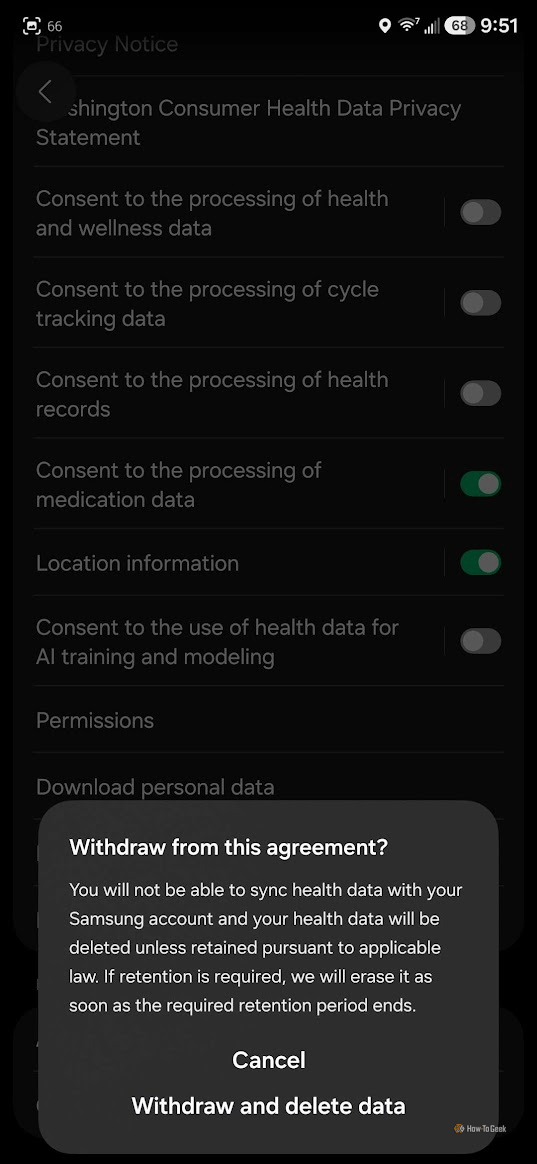
Withdraw from this agreement?
You will not be able to sync health data with your Samsung account and your health data will be deleted unless retained pursuant to applicable law. If retention is required, we will erase it as soon as the required retention period ends.
Samsung collects four types of data in Health:
- Health and wellness: biometric, nutritional, body composition, and sleep data.
- Medications: including prescriptions and dosages.
- Clinical exams and treatments.
- Menstrual cycle.
A message on Samsung’s website warns that people may have access to this data to review it.
***
Samsung’s biggest rival, Apple, is also preparing to make Apple Intelligence — its suite of generative AI tools embedded in its operating systems — mandatory starting from version 27.
Four awful new privacy-eroding features from Meta in a month
This comment from Bruno, on Bluesky (pt_BR):
Instagram launches new tool that drains your entire bank account and kills your family. Here’s how to turn it off 👇
Instagram doesn’t (yet) do that. His joke references the recent news that photos from public Instagram profiles could be used to generate new images on WhatsApp with Meta AI, Meta’s generative AI, which also owns Instagram. The press picked it up and led with “Here’s how to turn it off” in the headlines.

LineageOS now has a web installer. The project warns, however, that it doesn’t handle the entire process, and that you’ll still need to follow the instructions on your device’s wiki. Even so, it should make things considerably easier during those major yearly updates. In the same announcement, they report that work on LineageOS 24 — based on Android 17 — is “progressing nicely”.
Why does WhatsApp drain so much phone battery?
Scarcity makes us pay more attention to details. A clear reflection of living with limited resources, one of the things that has intrigued me is the tiny battery capacity of my phone.
It wasn’t the biggest when it was new and, four years later, reduced to ~82% of its original capacity and more demanded by major annual software updates, it now requires some planning on the days I know I’ll be away from power outlets for long stretches.
It’s not quite a problem because I work from home. Still, sometimes I find myself playing battery babysitter.