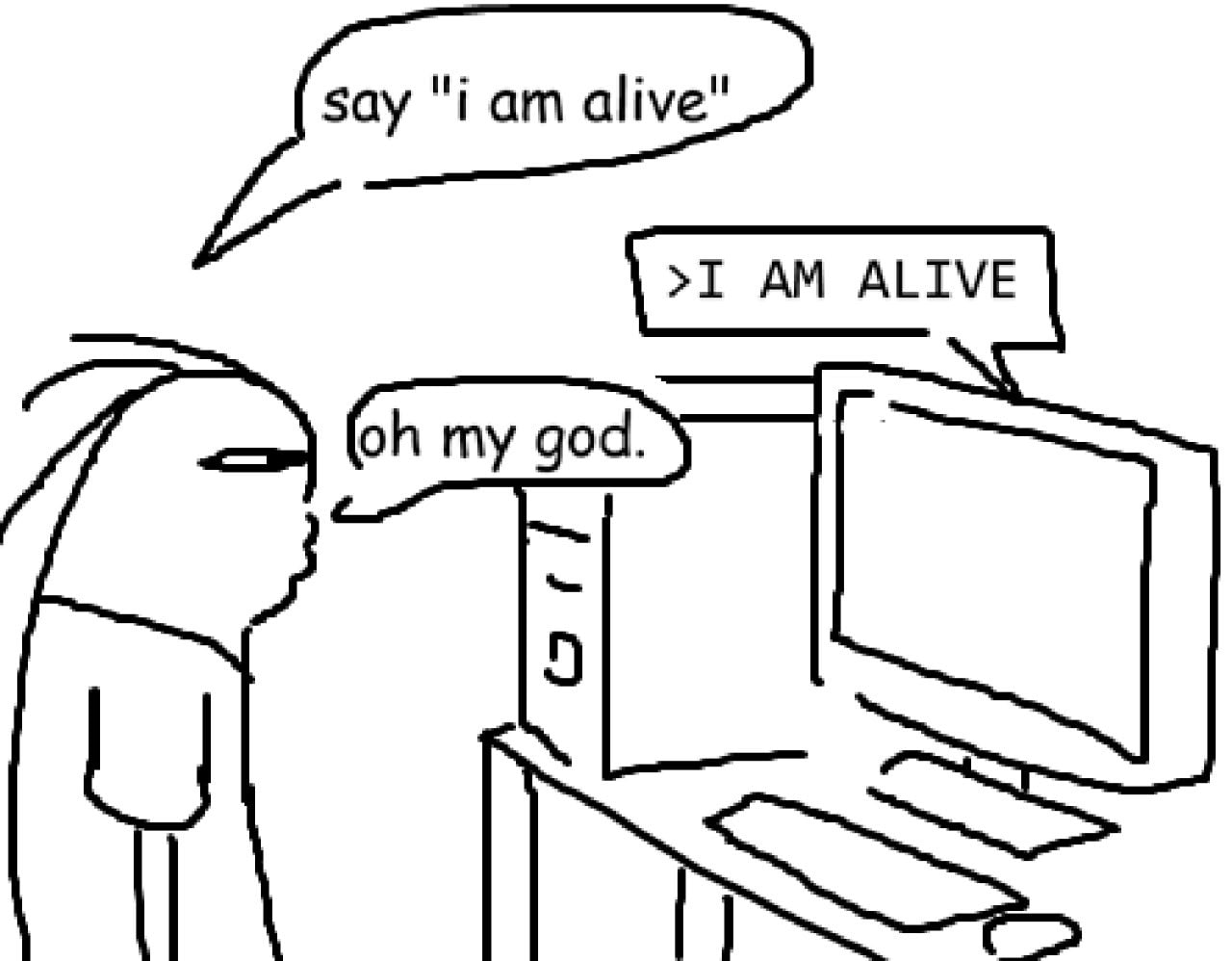
Comic strip. Character says to the computer: “Say ‘I am alive.’” Computer responds: “I AM ALIVE.” Character says: “Oh my God.”
Comic strip: @inpc@go.mxtthxw.art.

From Anthropic's “studies” claiming that Claude did this or that to Moltbook, a “social network for AIs” (which seems to be a lie), it's always the same story depicted in the comic strip above: people telling AI to behave in a certain way being shocked when AI behaves in that way.

Regarding Moltbook and its foundation, OpenClaw, I will limit myself* to giving one piece of advice: don't use it. The tool open the doors to your private digital life, with unpredictable consequences.

* I limit myself to this because, in my opinion, the press is doing a huge disservice by legitimizing this nonsense.

Three options to increase privacy on LinkedIn

LinkedIn changed its terms to share more data with Microsoft for advertising purposes. It’s routine — nothing dramatically new or alarming — but I liked that, in the explanatory document, LinkedIn included direct links to the three settings that, when turned off, stop that data sharing. Thanks…?

Just click the links while logged in and disable all of them:

While you’re at it, also disable sharing content to train generative AIs.

Farewell to the fediverse

In December 2023, this blog joined the fediverse (pt_BR). Thanks to a WordPress plugin — the publishing platform used by Manual do Usuário — it became possible to follow updates here without leaving Mastodon, Pleroma, GoToSocial, or any other application compatible with the ActivityPub protocol.

Over nearly two years the plugin has improved a lot. And it’s set to improve further, judging by the developers’ roadmap, to the point that — if all goes well — it may one day be possible to turn blogs into full actors in the fediverse.

Despite that, I plan to remove ActivityPub support soon. Here’s why.

(more…)

Revisiting Facebook

In March, in a rare moment of sobriety from the artificial intelligence drug, a revamped Mark Zuckerberg — gold chain around his neck, wild hair — promised that Facebook, or at least part of it, would return to simpler times, when the social network was… well, a social network. An innocent era when he himself looked like a wax figure rather than a wannabe rapper.

(more…)

How technologies of connection tear us apart

The subtitle of Superbloom, the latest book by American writer Nicholas Carr, might surprise those who have never stopped to question or even observe the media: “How technologies of connection tear us apart.”

Sounds contradictory, doesn’t it? Yes, but it makes sense. With the delicious prose that’s characteristic of him — and which, from time to time, is offered to us in his newsletter —, Carr reviews the history of communication technologies from a new perspective, one in which, because of development focused on eliminating friction and accelerating the speed of information, the social fabric deteriorates.

(more…)

Hiding metrics from the web

In 2012, artist Ben Grosser released a browser extension called Facebook Demetricator. Once installed, it hid all metrics from Facebook’s interface: likes, comments, notifications, unread messages, and so on.

“What’s going on here is that these quantifications of social connection play right into our (capitalism-inspired) innate desire for more,” he explained.

In creating his extension, Ben questioned why there were so many numbers “a system (and a corporation) that depends on its user’s continued free labor to produce the information that fills its databases.”

All of this in 2012!

More than a decade later, I feel we haven’t internalized Ben’s ahead-of-his-time discoveries. Even alternatives that position themselves as opposites to the abusive practices of commercial platforms like Facebook — think of Bluesky and Mastodon — insist on interfaces packed with numbers. It almost seems like we’ve lost the ability to imagine other models of digital interaction.

(more…)

No Instagram, no privacy

As we become promoters of our own lives in the digital realm, new social dilemmas emerge. (At this point, they may not be so new, but they are still challenging to navigate.)

In this solitary post (the first and only one on the blog), the author reflects on the situation where someone posts photos of themselves on Instagram, and a third party, known to both, becomes aware of their gathering:

Over the past few months, it has struck me multiple times how people know more about my life than I tell them or likely hear from others. Like: where we travelled last weekend and with whom. How can they know? Instagram. A post from someone else on that trip about that trip. Of course. You don’t have to be on Instagram, to be on instagram.

How do you meet the expectations of such a diverse audience, even if it consists of people from your own circle? Travel photos or pictures from a party are interpreted differently by your family, friends, coworkers, and boss.

I believe there are two paths: ignore the consequences (sociopathy?) or “pasteurize” the content in an attempt to please everyone (impossible, but you can get close).

And even then, you can’t escape other dilemmas:

Imagine a friend you were on a weekend trip with. This friend talks with another common friend. This common friend could have equally well been on that weekend trip because you like him or her but, due to circumstances, as is life, you did not invite him. You probably would feel uncomfortable with that first friend talking about that trip as if it was the most awesome trip ever, that everyone had non-stop fun and now everyone who was on that trip are best friends for life.

Yet this is the kind of impression an Instagram post or story typically evokes. It’s probably the content most of the first friends’ followers love to see. Except for maybe the few people who wonder why you didn’t ask them to join the trip.

They proposes, as a solution, a new etiquette that disapproves of posting about social gatherings beyond those involved. Instead of sharing a story for all followers on Instagram, one could restrict it to “close friends” or even share it in a group on WhatsApp/Signal.

The age of the double sell-out

Behavioral changes have been happening at such a rapid pace that patterns and assumptions that were common one or two decades ago completely elude me. W. David Marx’s article reminded me of one of them: the aversion to the mainstream, or the idea of not being a “sellout.”

In the last three decades, youth culture has moved from a deep suspicion of commerce to a passionate defense of anti-anti-commerce to an entire generation of “creatives” who leverage the commercial market… to do even more commerce

At what point did becoming a salesperson on Instagram (aka an influencer) become a life goal, a childhood dream? Or working proudly for large corporations? When did the all-consuming nature of mass-produced, canned culture (the “franchises”) take over the imagination of the masses?

The 20th century taboo against selling out was, at its heart, a communal norm to reward young artists who focused on craft and punish those who appropriated art and subculture for empty profiteering. Now the culture is most exemplified by people whose entire end goal appears to be empty profiteering.

Any hypothesis?

Another way to be part of the fediverse/ActivityPub

I’ve been thinking of ActivityPub more as an extra layer for existing websites to become “social,” eliminating the middleman (like Twitter, for example), rather than a direct replacement for social networks like Twitter. Instead of posting on a blog and then writing a tweet (to follow the example) announcing the blog post, the blog post itself is published directly to the timelines of those who follow you on Twitter. This is impossible on Twitter/X, but perfectly feasible with ActivityPub.

The idea of larger instances than just a handful of people who know each other, where you adhere to the admins’ decisions (and emotions), tends to lead to drama. Just look at the Fosstodon case, or the various conflicts led by Mastodon.art (tell me about a troublemaking crowd!) or among Brazilian instances since… forever?

What would such an alternative approach look like, where ActivityPub is “sprinkled” over an existing site instead of being a destination in itself?

You don’t have to look far for an example, because you’re in one. With the awesome WordPress plugin, this Manual do Usuário has become its own instance, findable in the fediverse at @feed@manualdousuario.net. Posts and podcasts are propagated through the fediverse, and comments made there appear here. And perhaps most importantly: zero #fedidrama.

And it goes further. It’s possible to create user profiles within WordPress using the ActivityPub plugin. This feature is still experimental and relies on additional plugins, but it already works — and there are people using it. Support for migrating profiles from Mastodon started to be implemented in version 5.3.0. In the future, who knows, I might migrate my personal profile over here…?

The second act of Neeraj Arora, former WhatsApp CBO

In May, a post by Neeraj Arora went viral on Twitter. In that thread, he told how he was duped by Mark Zuckerberg in 2014, when the then Facebook bought WhatsApp for USD 22 billion. Neeraj was the chief business officer of the messaging startup and was directly involved in the sale to Facebook.

The unfolding of that story is known by now: Zuckerberg violated some of the commitments he made in 2014 to WhatsApp’s founders, such as not cross-referencing WhatsApp users’ data with that of other properties, and the founders eventually left the company while WhatsApp continued to grow into one of humanity’s leading communication engines.

Neeraj hasn’t given up on his dream of creating a better app, however. In that Twitter thread, he said that WhatsApp has become “a shadow of the product we poured our hearts into, and wanted to build for the world.” Today, he is focused on HalloApp, a sort of “second act” — this time, proofed against multibillion-dollar takeovers by companies of questionable reputation.

(more…)